
The Venus Project
A Vision for a Resource Based Economy

A Vision for a Resource Based Economy
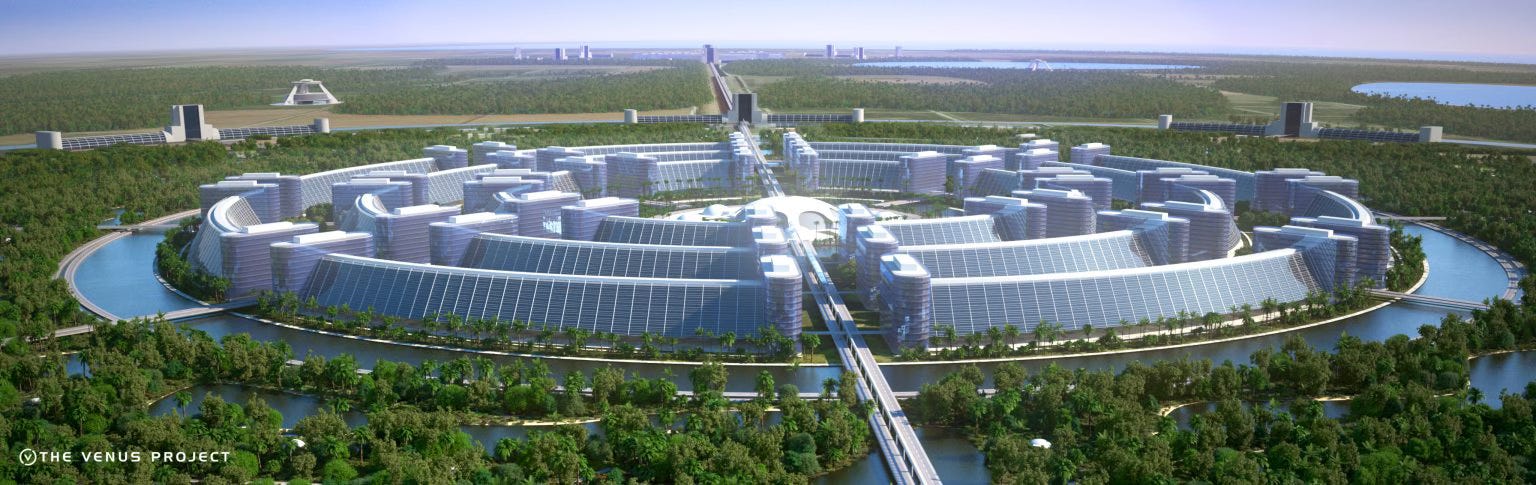
Global problems faced by humanity today are impacting individuals and nations rapidly. Climate change, energy contraction, famine, war, epidemics of deadly diseases, desertification, and environmental pollution contribute to the long list of global challenges we, as humans, need to promptly address before an eventual catastrophe swiftly becomes inevitable.
Regardless of political philosophy, religious beliefs, or social customs, all socio-economic systems ultimately depend upon natural resources, such as clean air and water, arable land, and the necessary technology and personnel to maintain a good standard of living.
Modern society has access to highly advanced technologies and can make available food, clothing, housing, medical care, a relevant educational system, and develop less contaminating energy such as geothermal, solar, wind and tidal.
Individuals and interest groups are governed by laws that demand maximum profit where possible. These laws are inherent in the monetary system prevalent in most countries today – capitalism. The basic principles of capitalism demand exponential growth at all cost causing financial cataclysms such as the 1929s Great Depression in the United States and the recent financial crisis of 2007-08.
We are separated by borders and beliefs which make it impossible for us to arrive at relevant solutions while being divided ideologically. Most of our problems today are technical but we are still looking for solutions through political means. We need to accept that eliminating these global threats requires the employment of methodologies rather than personal opinions.
“We cannot solve our problems with the same thinking we used when we created them.”
~ Albert Einstein
The Venus Project proposes a holistic approach with a global socio-economic system that utilizes the most current technological and scientific advances to eventually provide the highest possible living standard for all people on Earth. However, this depends on available energy, a correlation that is often overlooked. The proposed system is called a Resource Based Economy. The term and meaning was coined by Jacque Fresco, the founder of The Venus Project.
In a Resource Based Economy all goods and services are available to all people without the need for means of exchange such as money, credits, barter or any other means. For this to be achieved, all resources must be declared as the common heritage of all Earth’s inhabitants. Equipped with the latest scientific and technological marvels, humankind could reach extremely high productivity levels and create an abundance of resources.
Resource Based Economy concerns itself with three main factors, namely Environmental, Technological and Human. We invite you to investigate further into these factors and discover more about The Venus Project and Resource Based Economy.
The Venus Project imagines a civilization that:
Lives in balance with Earth’s carrying capacity
Grounds its understanding of reality in the scientific method
Uses engineering and technology to enhance human well-being
Unites humanity beyond artificial national boundaries
Guarantees access to life’s essentials — food, shelter, healthcare, education, and cultural enrichment
Recognizes Earth’s resources as the common heritage of all people and manages them equitably
Solves problems through prevention, guided by a holistic systems approach
Develops and shares technology for the advancement of all life
Designs and produces durable, high-quality goods rather than disposable commodities
Restores, protects, and regenerates natural ecosystems
Stabilizes population growth through education and voluntary family planning
Remains resilient and adaptive in the face of change
The Venus Project envisions a world free from:
War and militarization
Poverty and artificial scarcity
Crime and punitive justice systems
Monetary systems based on debt and exploitation
Servitude and economic coercion
Preventable disease and environmental pollution
Prejudice, elitism, and divisive nationalism
Market-driven incentives that distort human values
The Venus Project Initiatves:
The Venus Project: The Redesign of a Culture (1994)
This video presents a bold new direction for humanity, one which calls for no less than the total redesign of our culture. It gives a rare glimpse at what the human potential could be if we use the methods of science and technology only to serve the purpose of making society more humane. Fresco felt that with this approach we could for the first time begin to solve our century old problems of war, crime, poverty, hunger and a declining environment.
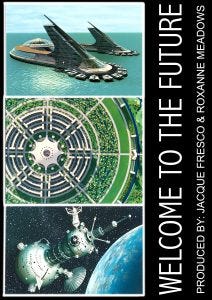
Welcome to the Future (1998)
This video presents an overview of Fresco’s socioeconomic system. Understanding the catastrophic possibilities that could confront society, Fresco in his era felt we still had time to render obsolete the existential threats that we now face. He foresaw what would inevitably come if we did not share resources as common heritage, eventually eliminating artificial borders between nations. This video forewarned that our survival is dependent on a pristine ecology, a relevant education, intelligent design and resource management, free access to goods and services, and living within Earth’s carrying capacity.
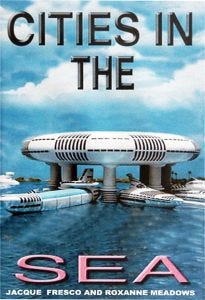
Cities in the Sea (2002)
This video demonstrates how sea structures could be important contributions to an almost limitless source of food, energy production, minerals, pharmaceuticals, and habitats for studying the reclamation of the ocean environment. Fresco felt that if intelligently managed, the creation of ocean communities could be among the twenty-first century’s greatest achievements. This video showcases a breathtaking array of his numerous oceanographic structures, their use, and potential.
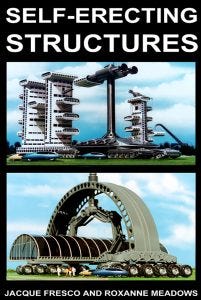
Self-erecting Structures (2003)
This piece illustrates the intelligent use of AI and cybernation to demonstrate the plausibility of worldwide reconstruction in the shortest time possible thus providing a more humane future. It demonstrates how automated systems assemble huge structures over canals that desalinate water. We see mega high-powered laser machines directed by satellites fuse the earth into molten magma-like material, contouring the ground into canals, highways, and waterways. Apartment buildings of foamed concrete are demonstrated being extruded, separated, transported to the site, and lifted into place. Automated catamarans place bridge components in locations where they interlock to form a complete bridge assembly and much more. It forewarns us that it is not technology to be feared but rather its abuse and misuse, putting the decision on us whether we use machines to elevate people everywhere or to serve our fears, prejudice, and power-seeking.
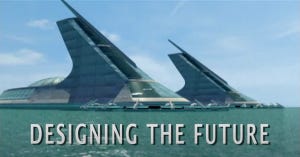
Designing the Future (2006)
This is an overview of Fresco’s designs and concepts to attain a world of Global Stability. To help achieve this, It posits the building of entirely new circular cities. This would require overall planning, sophisticated construction techniques, ease of assembly and maintenance, simplicity, durability, and prefabricated elements that meet many different requirements for achieving total self-sufficient cities. This results in the minimum energy expenditure enabling more amenities for its inhabitants. A result of this approach is that only one-eighth of the city needs to be designed and then duplicated. The video delves into many aspects of this integrated city such as transportation, mass-produced housing, clean energy sources, bridges, and canals, to the central cybernated complex which displays in real-time the operational data of the entire city.
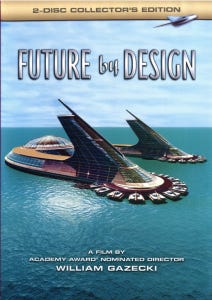
Future By Design (2006)
Although this film was not produced and developed by The Venus Project it is an important documentary directed by William Gazecki. It was one of the first films produced about Jacque Fresco with a substantial budget and an acclaimed filmmaker. Of the many documentaries made about Fresco, while it is not the most comprehensive regarding his philosophy and socioeconomic system, it is the most salient in capturing his life’s story. In “Future By Design” he explores his childhood through the age of 90 (his age at that time). One gets a sense of the urgency he felt for the time constraints we had. He describes events that influenced him to spend his entire life conceiving, formulating, and relentlessly trying to update the social paradigm.
About Jacque Fresco
Jacque Fresco’s background includes industrial design and social engineering, as well as being a forerunner in the field of Human Factors. Mr. Fresco worked as both designer and inventor in a wide range of fields spanning from biomedical innovations to totally integrated social systems.
The Venus Project reflects the culmination of Mr. Fresco’s life work: the integration of the best of science and technology into a comprehensive plan for a new society based on human and environmental concern. It is a global vision of hope for the future of humankind in our technological age.
Mr. Fresco was a guest lecturer at many institutions of higher learning. He addressed students at the University of Miami, Princeton, University of Southern California, Dade Junior College, Queens College, Presbyterian College, University of Southern Florida, Nichols College, Columbia University, Instituto Tecnologico de Estudios Superiores de Monterrey in Monterrey of Mexico, Institute of Technology in Vienna, Austria, Penn State Greater Allegheny, Nova Southeastern University, City London University, University of Michigan, and others.
He and Ralph Nader were featured guest lecturers at the University of South Florida. At Princeton University, Mr. Fresco addressed the Department of Sociology. His subject was Sociology of the Future. Along with the well-known anthropologist Margaret Mead, Mr. Fresco was extended an invitation to address the College Environment Conference in Washington, DC. He was a guest speaker for the Tenth Symposium for the Civil Engineering Department of TEC de Monterrey University in Monterrey, Mexico, Latin America’s top rated college.
Is a Resource Based Economy Inevitable?
The vision of Fresco is bold, technological, and morally ambitious. It imagines a civilization organized not around profit, debt, and scarcity but around stewardship, science, and shared abundance. It calls for humanity to transcend borders, artificial limitations, and economic systems that reward exploitation over sustainability.
These ideas, articulated by Jacque Fresco and developed through The Venus Project, are not merely utopian fantasies. They are structured proposals grounded in engineering, systems thinking, and a belief that technology can elevate rather than enslave humanity.
Yet an important question remains:
While the visions here are powerful, important, and surely part of the answer to building a future world can we truly create a resource based economy?
Many technologists argue that artificial intelligence, automation, and advanced energy systems will generate unprecedented abundance. Elon Musk, among others, has suggested that AI-driven productivity could eventually render traditional labor and perhaps even money itself largely obsolete. If machines can produce goods, design systems, manage infrastructure, and distribute resources with extreme efficiency, what role does scarcity based currency continue to play?
If abundance becomes technologically feasible, do we not naturally begin gravitating toward a system where the funding of public goods as opposed to private accumulation becomes the central aim?
When marginal production costs approach zero, when energy becomes nearly limitless, when AI optimizes logistics and eliminates waste, does a monetary system rooted in scarcity begin to look structurally outdated?
Perhaps the transition would not be ideological but evolutionary.
Perhaps a resource based economy is not something imposed by revolution but something that emerges when technology makes it inevitable.
The deeper question is not whether we want such a system.
It is whether the trajectory of AI, automation, and energy innovation will make it unavoidable.
If the purpose of economic systems is to allocate scarce resources efficiently, then what happens when scarcity itself begins to dissolve?
In that world, the ultimate measure of progress would no longer be GDP or market capitalization, but ecological restoration, human flourishing, public health, education, cultural enrichment, and planetary stability.
The challenge before us is not merely technological, it is philosophical. Are we prepared to redefine value itself?
If abundance is possible, then a resource based economy may not be a radical alternative.
It may be the next logical stage of civilization.